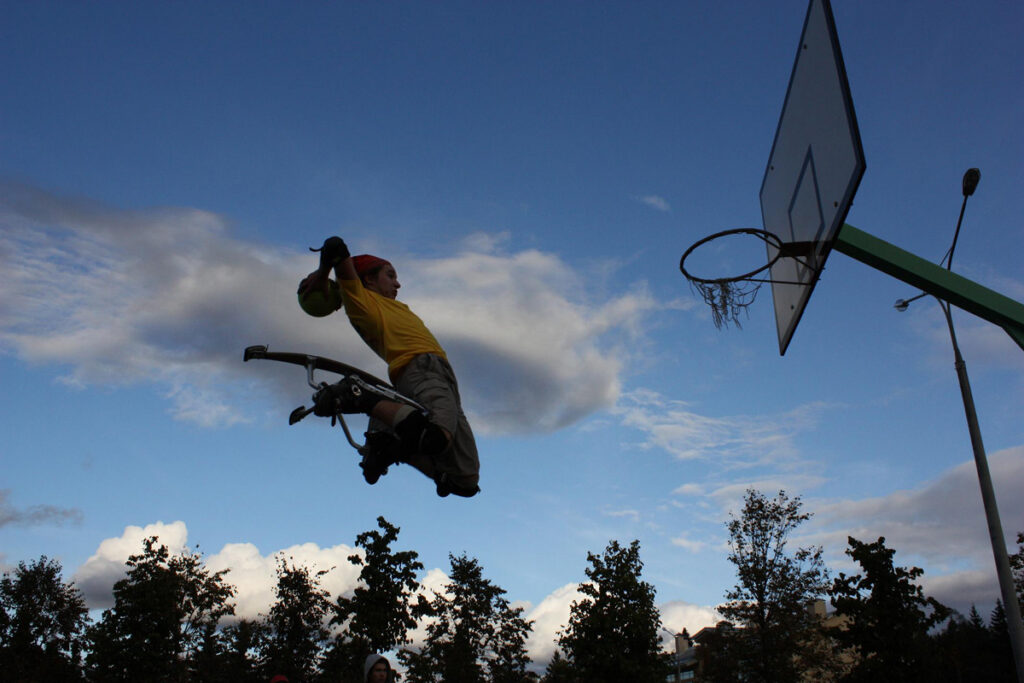
Powerbocking, or simply bocking, is riding jumping stilts as a sport: long springing strides, jumps and, for experienced riders, flips and spins. The name comes from Alexander Böck, the German engineer who designed the original spring stilt. [1]
Where the name comes from
Böck’s design carries a priority date of July 20, 1999. It was patented in Europe (EP 1 196 220, granted 2003) and in the United States (6,719,671, granted 2004), and it reached the market as the Powerskip. [1] Riders borrowed his surname for the activity, while the gear itself picked up a string of other names: jumping stilts, power stilts, bounce stilts, spring stilts and, in plenty of online shops, pogo stilts.
How the spring does the work
Each stilt straps to the lower leg at the foot, ankle and calf. Below the foot plate, a fiberglass leaf spring curves down to a rubber hoof. Step down and your weight bends the spring; as it straightens, it pushes you up and forward. Your legs add a little effort at the right moment, and the spring supplies much of the lift. That is also why the spring has to suit the rider’s weight, as our weight guide explains.
How riders build up to it
- Stand. With a helper at each side or a fence to hold, rise slowly and find your balance. The spring flexes a little even while you stand still. That is normal.
- Walk. Take short steps with soft knees, looking ahead rather than down at the hooves.
- Stride and bound. Lengthen your steps until the spring begins to lift you between them. This is the point where riding starts to feel like flying.
- Jump. Begin with small two-footed hops and land on both hooves together. Height comes from timing, not from pushing harder.
- Tricks. Spins, flips and dunks are for riders who can already run, jump and stop on command. Learn them alongside experienced riders, never alone.
Where to ride
Learn on short, dry grass. It forgives falls, and every new rider falls. Once you can walk and stop when you choose, move on to smooth, open hard ground such as an empty court or a quiet path, well away from traffic. Stay off public roads, stairs, steep slopes, wet or icy surfaces and anywhere crowded.
What to wear on every ride
- A helmet that sits snug and level, skate or bike style.
- Wrist guards: when you tip forward, your hands go out first.
- Knee pads and elbow pads.
- Closed-toe sport shoes that fit flat on the foot plate.
- For the first sessions, a helper standing close enough to grab an arm.
Riding with others
The sport has a small but long-running event scene in Europe. The Nancy Power Days in France have been held since 2009, and the Riser Winter Cup in Lille since 2015. [1] About 200 performers on jumping stilts also took part in the closing ceremony of the 2008 Beijing Olympics. [1] In the US, most riding happens in local groups, so look for one near you before heading out on your own.
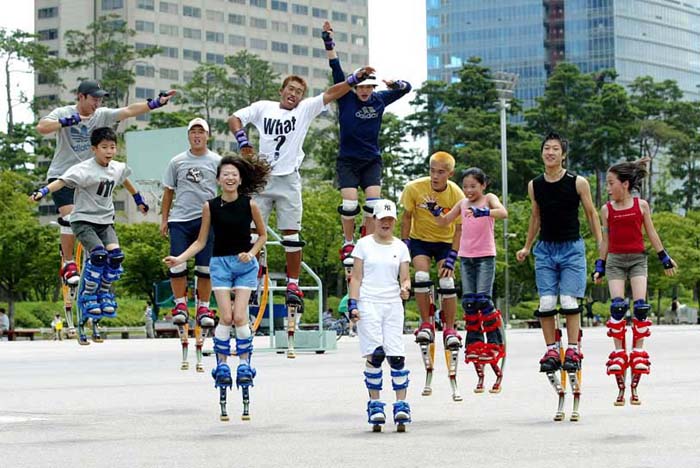
New riders over 110 lb usually begin on an adult pair such as the Adult Jumping Stilts, Blue/Silver in the band that matches their weight. Lighter riders from 66 lb start on one of our kids’ pairs.
Ready for a first ride?
Pick a pair for your weight
Adult pairs in four bands from $235, kids’ pairs at $175.
Sources
- “Jumping stilts.” Wikipedia. en.wikipedia.org/wiki/Jumping_stilts. Accessed November 17, 2026.